Awards
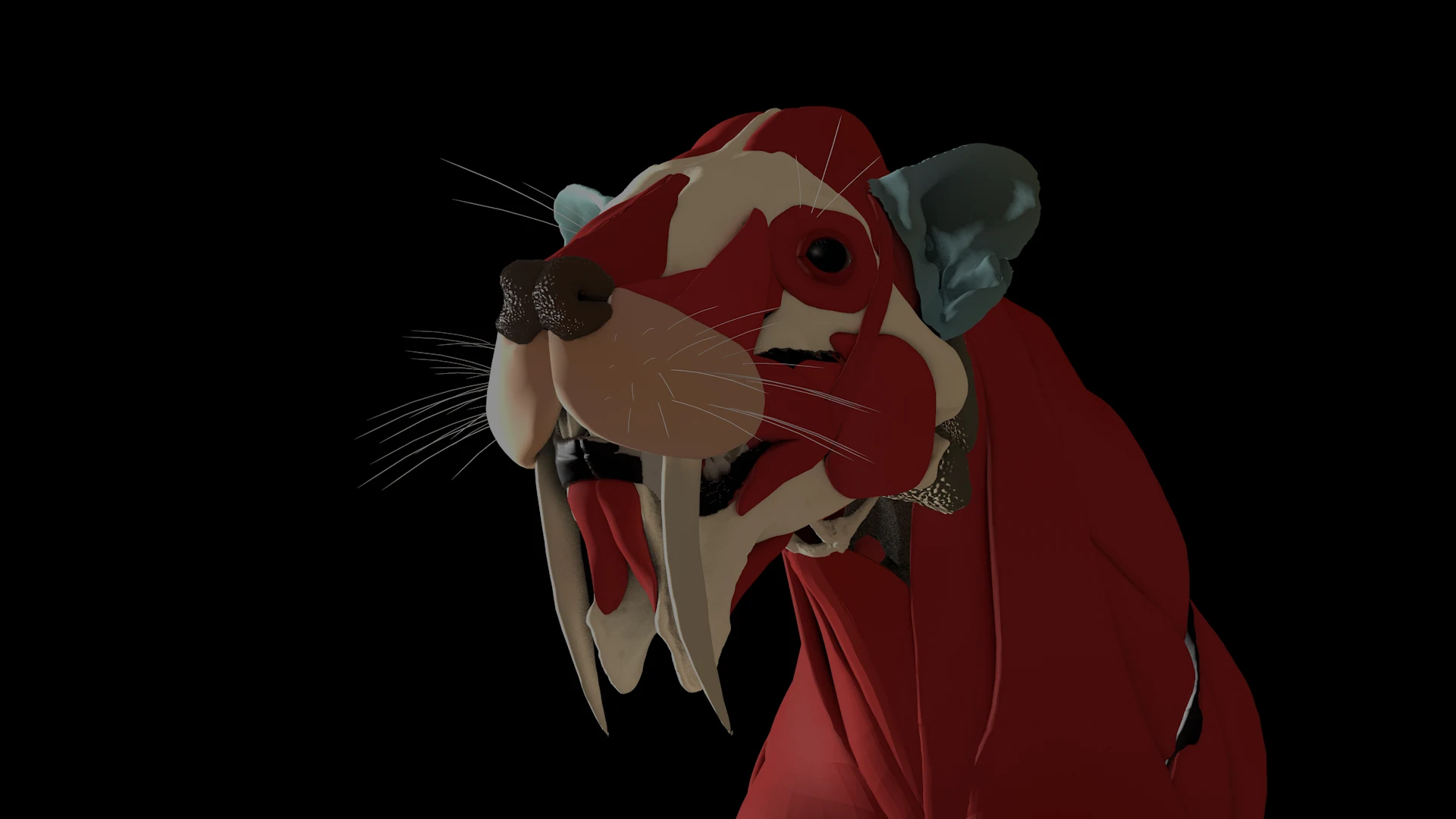
Head reconstruction of Barbourofelis fricki
Premio Italiano di Paleoarte - Montevarchi 2025 — WINNING PROJECT
Resume
THE SPECIES
Several predators lived during the Miocene: amongst these, one in particular stands out for its distinctive morphology. Barbourofelis fricki was the medium-sized carnivore that best embodied the concept of a ‘sabre-toothed predator’. The postorbital bar, the extremely hypertrophic canines, the long mental flanges, the large carnassial teeth and the compact skull make it one of the species best adapted to the morphology of a sabre-toothed predator, rendering it more specialised than better-known taxa such as Smilodon and Thylacosmilus. Its body must have resembled that of a felid but with a semi-plantigrade posture. The tail is absent from the fossil record; its length therefore remains unknown. This feliform belongs to a family of uncertain taxonomic status: the Barbourofelidae probably form, together with the Nimravidae, a clade that is basal to all feliforms known today.
THE PROJECT
The project comprises the creation and visualisation of a 3D model showing the inferred anatomy of the head region of Barbourofelis fricki, along with a related presentation; both are available free of charge and accessible online. The 3D model was created following the standard process of palaeoart research and production, emphasising the use of 3D technologies and certain statistical inferences to ensure greater precision and reliability in decision-making.
DATA COLLECTION
The collection of material and data was essential, both to provide a foundation on which to work and to study the anatomical details of different species.
SOFTWARE USED
Cinema 4D was used for the modelling and rendering stages. Rhinoceros 3D was used for morphometric measurements. Photoshop was used for the final rendering.
PALEOART
The process leading to the final rendering begins with the creation of muscles, cartilage, mucous membranes, glands and other soft tissues. Knowledge of animal anatomy, particularly that of mammals, is essential to achieving a high degree of realism. The 3D model serves as a virtual anatomical atlas of a species that has no modern-day counterparts. The final rendering illustrates what the animal might have looked like in life.